
You file it yourself — we prepare everything
They broke the law.Make them pay you.
When a credit bureau or debt collector breaks the law, credit monitoring just watches and letter tools just ask. 28Solutio hands you the whole case — dispute to default judgment, court-ready — and you keep the statutory damages.
$3,000 example recovery · 3 × $1,000/violation

What you can walk away with
Willful violations found:3
3 violations: $300 to $3,000 in statutory damages
statutory damages, recoverable
+ actual damages on top of that — the real losses they caused you
What you pay: $35/letter or $49/mo · Run your own numbers →
15 U.S.C. §1681n(a)(1)(A) · willful violations
Courts set the amount within the statutory range, and only for violations proved willful. Illustrative — not a prediction, promise, or legal advice.
49
states + DC mapped
CA & TX court-ready today
The whole case, in your pocket
Dispute, file, and collect —
from one app.
The FTC found more than 1 in 5 consumers had a verified error on a credit report — and under the FCRA, an error the bureau refuses to fix can become a willful violation carrying $100–$1,000. 28Solutio finds them, cites the exact statute, and builds the paper trail that holds up in court.
Source: FTC · 2012 report to Congress (Section 319)
- Certified dispute letters that cite the exact statute
- Court-ready complaints, POS-010, CIV-100, JUD-100
- Every FCRA / FDCPA deadline tracked across defendants
Willful FCRA violations carry $100–$1,000 each in statutory damages (15 U.S.C. §1681n). Negligent violations recover actual damages only (§1681o). Figures shown are illustrative.
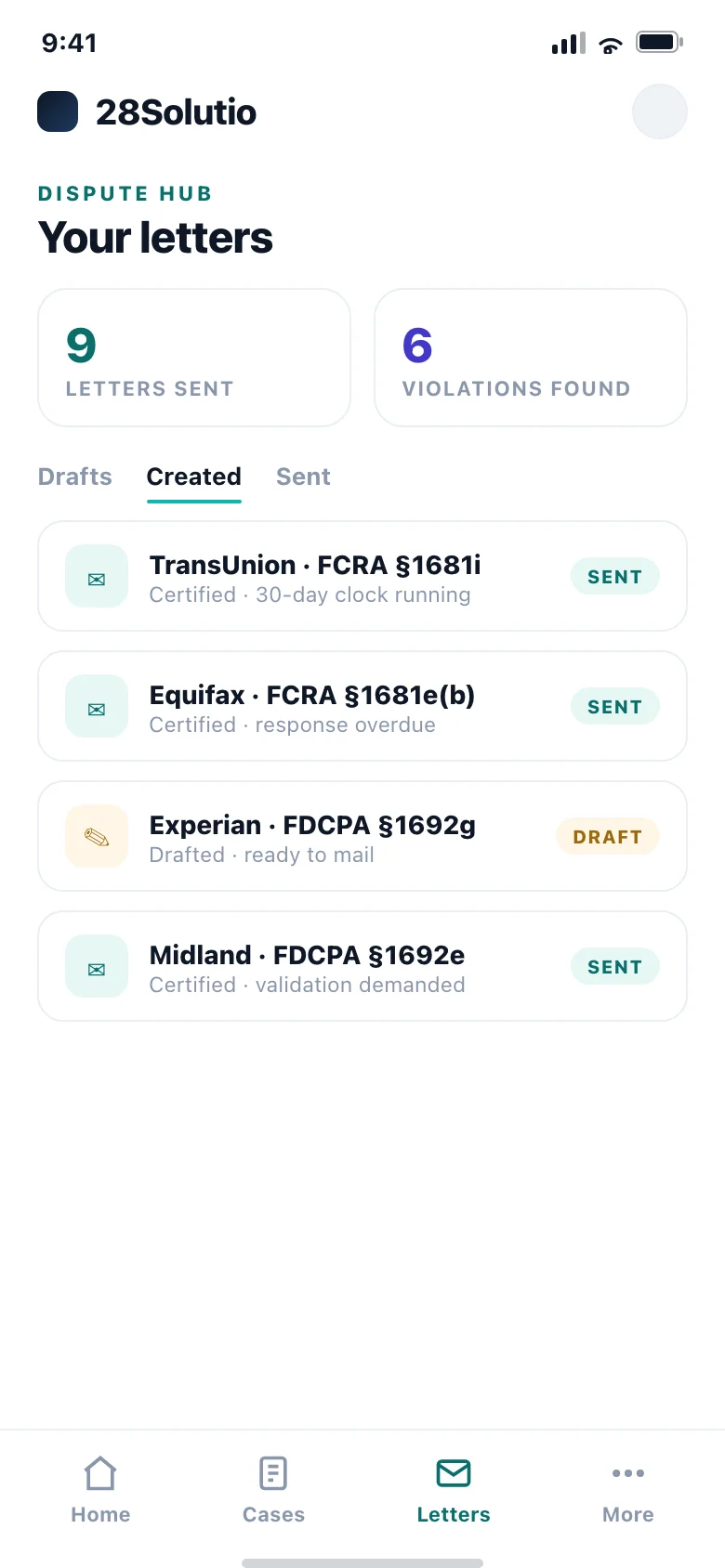
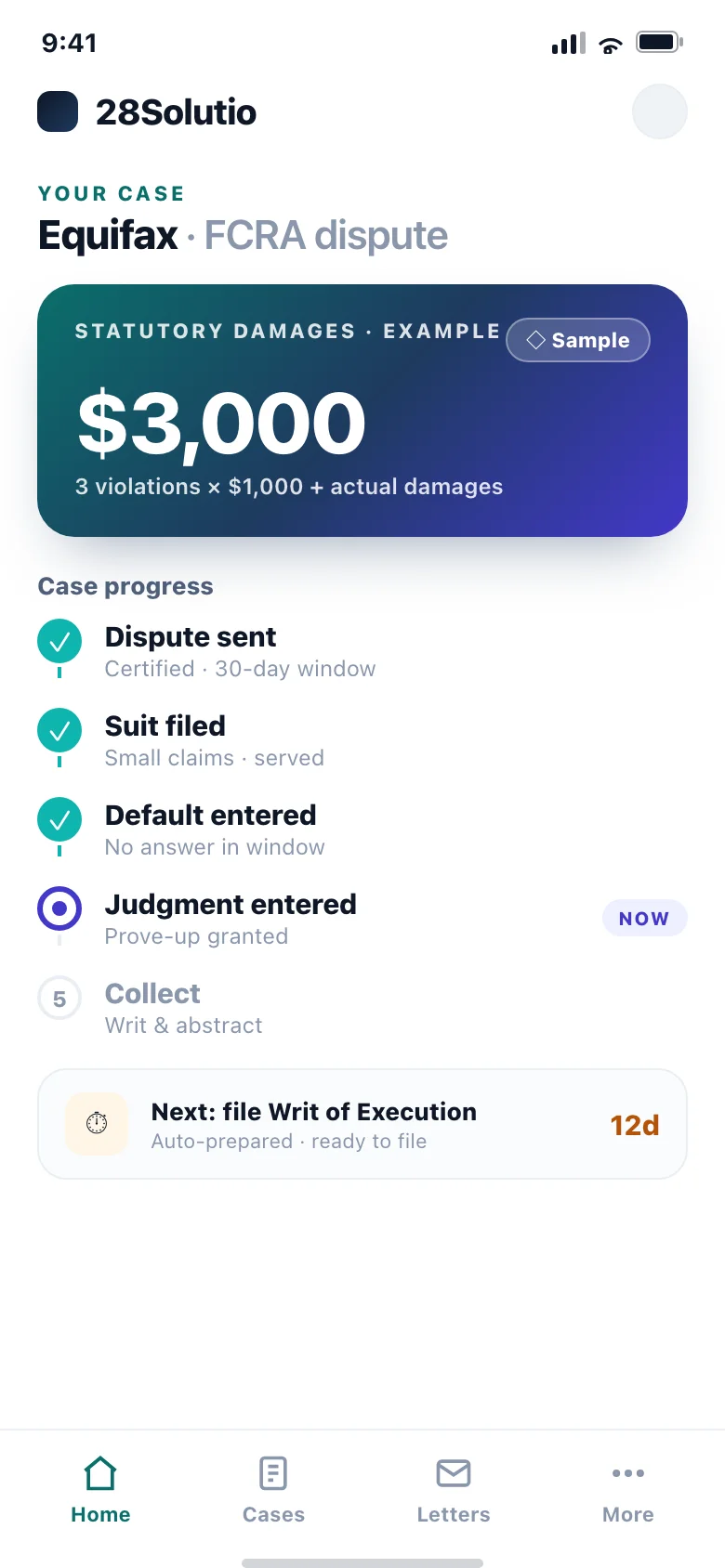
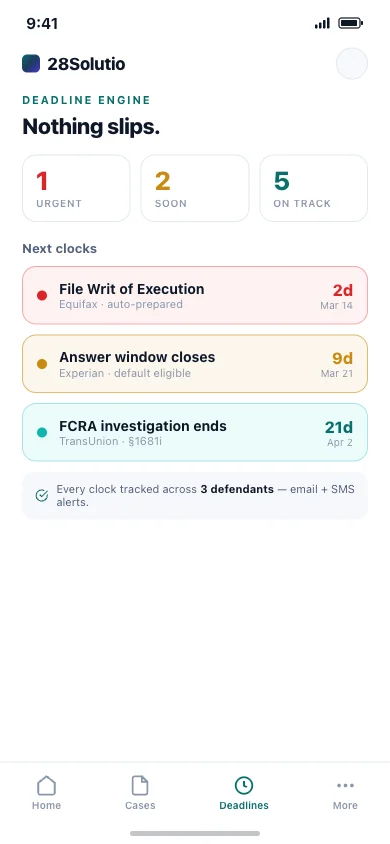
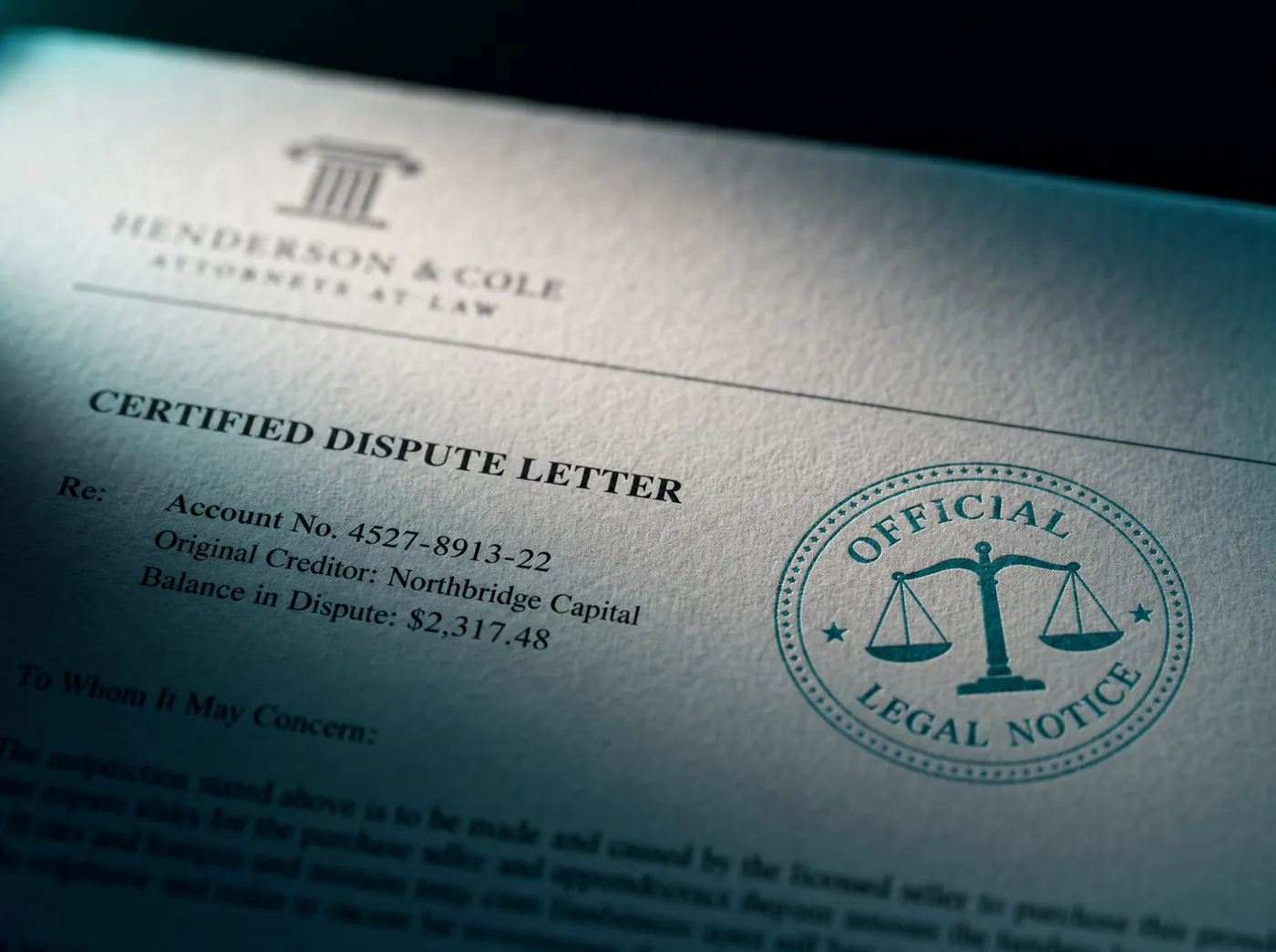

What lands in your case file
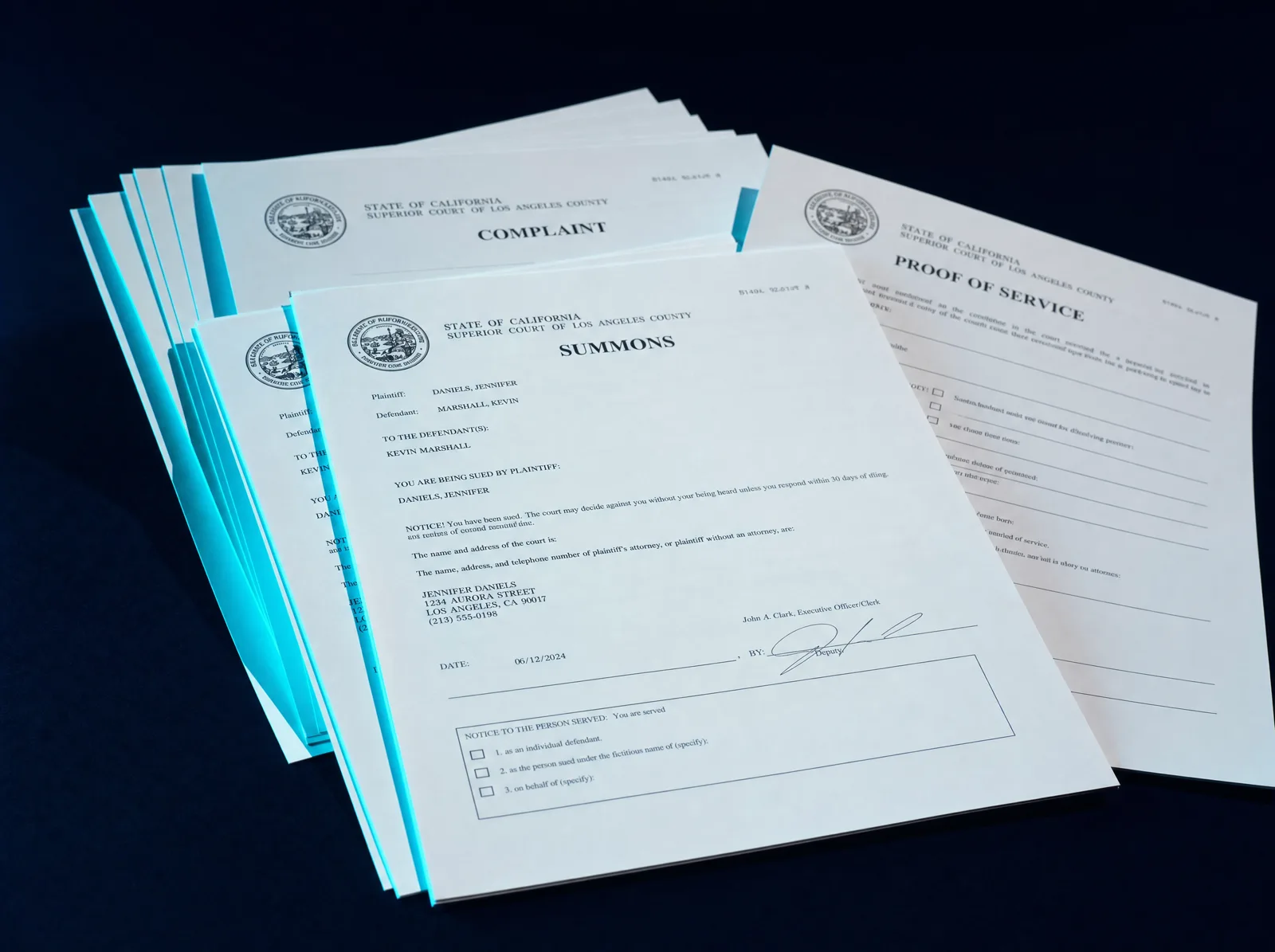
The actual court paperwork —
generated for you.
Not a template to wrestle with. 28Solutio assembles the real, court-ready forms your county expects — filled from your case, ready to sign and file.
- Summons & Complaint — the suit itself, caption and all
- Proof of Service — so the answer clock starts clean
- Default-judgment packet when they don’t respond in time
The path to getting paid
CA & TX court-ready · 49 states + DC mappedFrom a disputed line to money in hand.
Four steps, one engine. The same system that drafts your first dispute letter prepares the writ that collects your judgment — court-ready in California & Texas today, expanding toward all 50 states + DC.

Step 1 · Dispute
Turn a bureau’s silence into a federal violation.
We prepare FCRA dispute letters that cite the statute by section — ready for you to mail certified to all three bureaus. When the bureau lets the 30-day clock run out, you’re left holding a documented violation and the evidence your case is built on.
$100–$1,000per willful violation (§1681n)
Prepared for you
FCRA §1681Certified mail
The other situation
Wait — did a collector sue you?
Don’t ignore it — silence is how they win by default. Find your response deadline and make them prove the debt before the clock runs out. Straight answer: for California and Texas justice courts we now prepare your Answer — free with a free account; everywhere else, the free calculator plus your state’s own court form gets you filed on time. Just want the calls to stop? That’s the FDCPA validation letter — once it’s sent, the collector must pause collection until they prove the debt. We prepare it; you mail it.
Response-deadline estimator
I was sued — what do I do? →Pricing
Pricing, minus the maze.
Start with a letter. Win the whole case. Pick what fits right now.
The moat
Pro — win by default
$49/mo
$39 to start · cancel anytime
Unlimited disputes, plus your court-ready complaint and default-judgment packet — included, generated for you to file. When they don't answer, you keep 100% of the statutory damages.
See the litigation plan →Dispute letters
$35/dispute
pay-per-use · no subscription
Start here: AI writes it, we print it, and mail it USPS certified to all three bureaus. Your dashboard tracks delivery and the 30-day reinvestigation clock.
Start a dispute →Straight with you
No lawyer's name on the door.
Just the truth, on the record.
We'd rather lose your business than flatter you into a case you can't win. That's the whole difference — we show our work instead of asking you to trust a title.
If your case belongs with a lawyer, we tell you.
Strong, fee-shifting cases can cost you $0 with a consumer attorney — our triage says so and points you to free ones. We don’t hoard cases we shouldn’t take.
We tell you when you don’t have a case yet.
The intake grades your evidence honestly — if proving they received your dispute is the weak link, we say so instead of selling you a filing.
Not a law firm — you file it yourself.
We prepare the court-ready paperwork and track every deadline; you stay in control, and we say exactly that on every page. No hidden “representation.”
Cancel anytime, no lock-in.
You always see the price before you pay, and you can cancel from your account settings without calling anyone.
Solutio is Roman law for the moment an obligation is lawfully extinguished — paid, satisfied, discharged. It is the second half of our name, and it is the last status a case can reach here. Not every case gets there.
The law already wrote you a check. We help you cash it.
Upload your report. We find the violations, generate the letters, and build the lawsuit packet if they don't fix it. You file — we track every deadline.